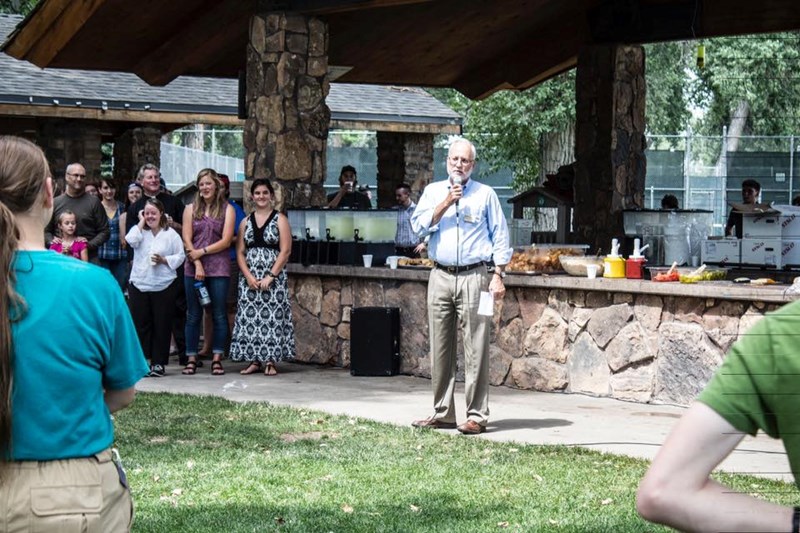
“Stetsons and Snowball Fights:” Unusual Commencement Setting Highlights WCC’s Unique Educational Vision

It takes an unusual kind of student to attend Wyoming Catholic College. Nestled in the foothills of the stunning Wind River Mountains, the College’s rigorous Great Books curriculum, world-class outdoor program, and visionary technology policy attracts a particularly adventurous kind of student—young men and women of “grit and grace” who are eager for something electrifying and transformative in the increasingly-homogeneous world of higher education.
This year, the forty-three seniors who processed across the stage of the Lander Valley Community Center to receive their diplomas experienced a particularly unusual Commencement even in WCC terms, as an unusually late Spring snowstorm blew into town Sunday evening, depositing over 8” of snow on the town between its arrival and the end of the Graduation festivities.

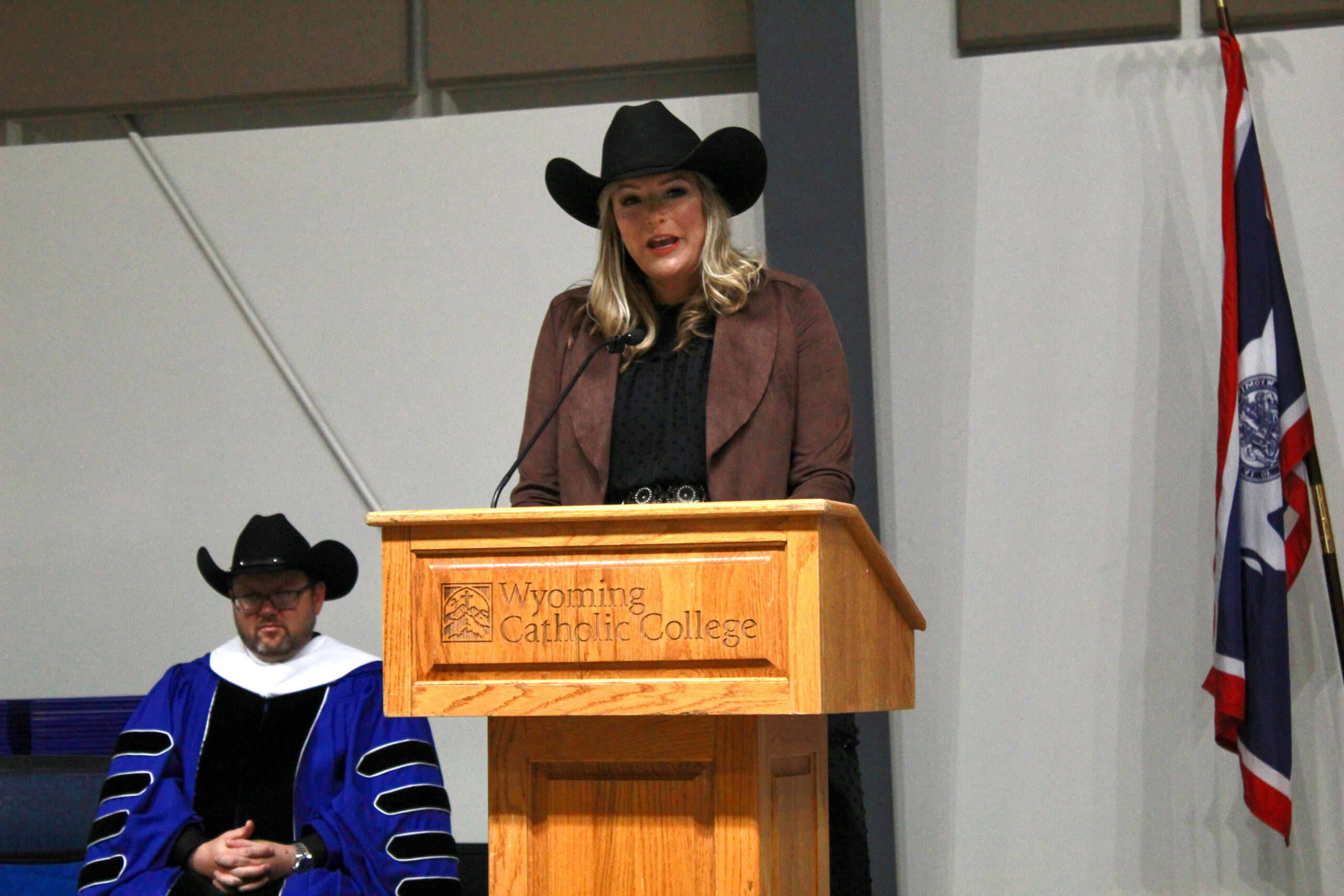
This year’s Commencement Speaker, CatholicVote’s Kelsey Reinhardt, who declared the opportunity to speak at the Lander-based institution’s year-end ceremonies “the honor of a lifetime,” used much of her speech to reflect on the ways in which the College’s graduating seniors have been influence by all three nouns in the College’s name, and the unpredictable (but beautiful) weather made her Wyoming remarks particularly relevant:

You have spent four years here in the womb of a people made by this land. You have drunk from its streams and its views. You have ridden horseback across plains that acquaint you with limitation and call you to community, while also preparing you for isolation and hardship. You have learned, not abstractly but bodily, that freedom is not the absence of limits. Freedom is the habit of moving well within reality.

…Where land has shaped you, memory must now guide you. Take with you the stars unfettered by light pollution. Take with you the crispness of fall air at the beginning of each academic year. Take with you the coziness of an all-too-early snow and an all-too-long winter (is it still winter?). Take with you the daring heights of mountain vistas, the ridiculous thrill of wearing shorts in spring when it is fifty degrees, and the fun of summer campouts in scorching heat.

Take also the discipline Wyoming gave you. Take the knowledge that not everything worth having is convenient. Take the reflex to help your neighbor without making a speech about it. Take the capacity to endure weather, silence, distance, and discomfort. In an age increasingly engineered to spare us from friction, you have received the gift of friction. Do not cease to remember it.
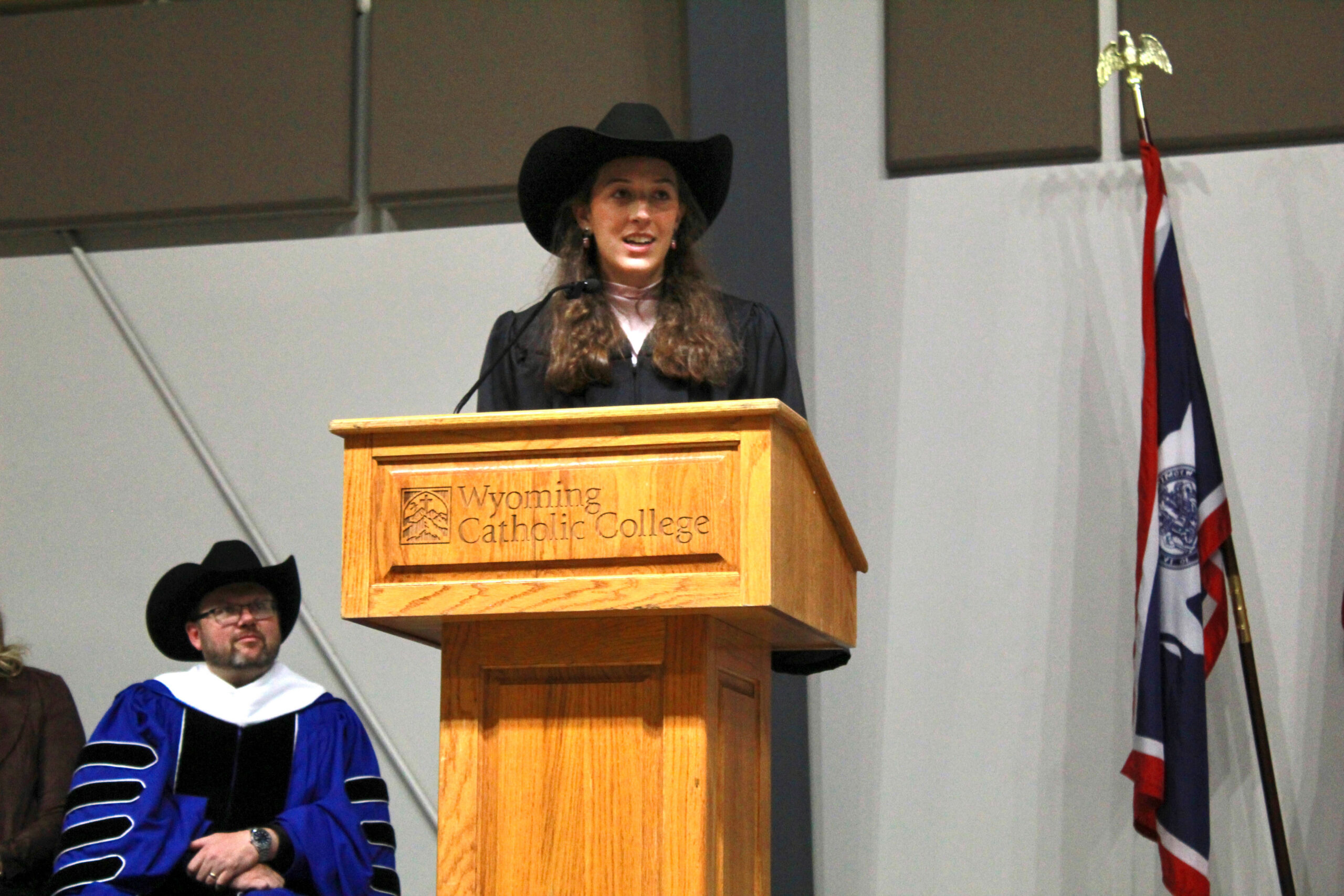
Earlier in the ceremony, during her Senior Address, Isabella Ramsay (’26), from Austin, TX, reflected on that same gift of “friction,” and on the way in which the snow falling softly outside seemed a particularly fitting finale to her class’s time at the College. She reminded them of their “21-Day Expedition” trek, back in July, 2022—each class of Wyoming Catholic College students spends its first month in the Wyoming backcountry, which the College likes to describe as “The Best Freshman Orientation in the Country—and of the fact that the groups struggled to bond until they experienced a torrential downpour. “It was that shared adversity, that shared struggle,” she noted, “that drew us together and formed us as a class.”

She also reminded them of their first winter in Lander (in late 2022), which was one of the harshest in recent memory, and that for many of the Californians or Texans in their class, it was their first real brush with the cold and with the snow. The “friction” of those conditions, again, drew them together, she said, helping them to overcome that adversity and bond more closely. But following upon that shared adversity and bonding, she pointed out, was something else that was even more important to their time at Wyoming Catholic: Love. Thanks to their time in Lander and to the 10+ weeks they spent in the beauty and challenge of the Rocky Mountain West, “We know about the created world,” she said. “We know about reality; that God looked at it and saw that it was very good. Reality itself is always drawing us in to fall in love. It’s always asking us to fall in love.” She exhorted them to remember their struggle, their shared adversity, and that love as they move on from their time at the College.

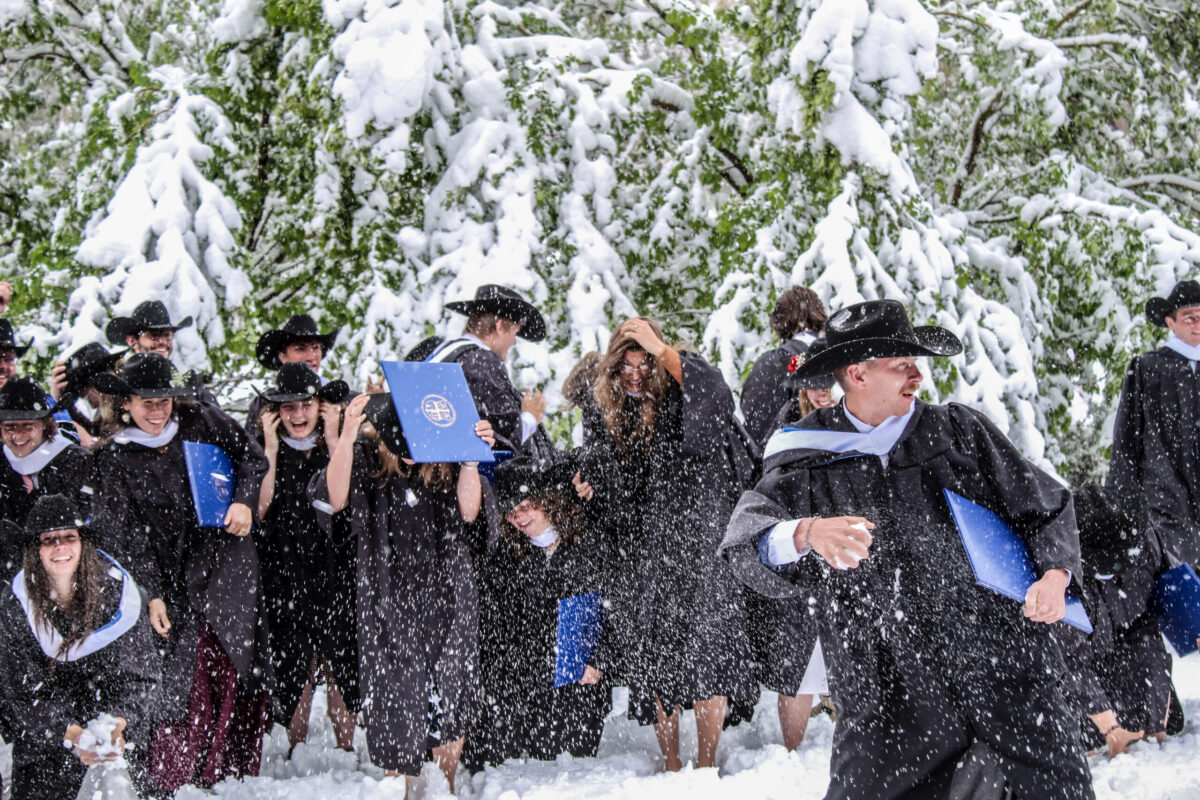
Later, after the conferral of degrees and the formal class picture, taken on the Community Center stage this year rather than outside, in a nod to the conditions) brought the ceremony to a close, the Class of 2026 found the perfect way to embody Ramsay’s and Reinhardt’s exhortations. Heading outside into the feathery whiteness for a final class photo, they finished off their time at Wyoming Catholic College with a spontaneous, riotous snowball fight, pelting one another furiously for several moments, including the assembled friends, family, and professors who were standing by. The blanketing white backdrop threw the black robes, blue hoods, and legendary black Stetsons each student was wearing into sharp relief, producing some of the most striking and joyous graduation photos we’ve seen at Wyoming Catholic College—or anywhere else, for that matter.

[jzsa-album link=”https://photos.google.com/share/AF1QipMQLTHcnYNerOk-mIwv35irQOhCixIcuNXHDXY5-fhmLcMrqBEEcMQ4OFalscmqXg?key=Tml6eDA1b1pvZ1lDZXVjd20taU4xNUlYSkZ2QUl3″ mode=”slider” limit=”35″ corner-radius=”10″ mosaic=”true” width=”800″ height=”533″ mosaic-count=”10″]
President Reinhardt captured the hilarious chaos of the ensuing fight, posting it to social media with the observation that “You’ve gotta be tough to go to a school where it still snows in May….”

Amy Welborn, Catholic columnist and author, was in Lander for the occasion—her son is a member of the Class of 2026—and in addition to capturing the snowy carnage for Instagram, she noted how fitting the moment was. “Fitting, not only because, well, it’s Wyoming, and as the college’s social media said, it’s a state full of surprises, including with the weather. But also – and more importantly – the snowfall, and the students’ – and faculty’s and guest’s – interaction with the unexpected blanketing – became an expression of what the school, and by extension, the best of Catholic life, is about: Accepting the gift of life and recognizing the grace of each moment – and going with it, in joy.”

Joy and grace, indeed, and a uniquely memorable and fitting farewell to the Class of 2026!

The Class of 2026
Sintia Maribel Albeño (Benque Viejo del Carman, Belize)
Annika Marie Allan-Burke (Ave Maria, FL)
Jessica Michelle Atkins (San Diego, CA)
Ray Barrett Baldwin V (Brewster, NY)
Michael Thomas Barrow (Austin, TX)

Emma Victoria Bleisch (Sammamish, WA)
Vivian Grace Borges (Wasilla, AK)
Annmarie Elizabeth Bridge (Delafield, WI)
Diego Alejandro Charles (Adkins, TX)
Nathan Joseph Clark (Orange, CA)

Benedict Karol Collins (Ojai, CA)
Grace Katharine Coughlin (Villa Park, CA)
Florian Athanasius Covington (Liberty, SC)
Gemma Justine Davidson (Aurora, CO)
Cecilia Seton Dax (Hartford, WI)

Aeja Magdelena DeKuiper (Twin Lake, MI)
Michael Jacob Dubruiel (Birmingham, AL)
Isabella Kate Ecoff Wagner (Indianapolis, IN)
Maile Alana Escalona (Maxwell, TX)
Liam Ignatius Federoff (Vail, AZ)

Patrick Theodore Gleason (Charlotte, NC)
Anna Marie Grumbine (La Crescenta, CA)
Carolina Laurel Gutierrez (Camarillo, CA)
Joseph Thomas Henderson (Basehor, KS)
Paxton Elijah Huemiller (Algona, IA)

Alden Francisco Jewell (Kennewick, WA)
Quinn Riley Lynch (Des Moines, IA)
Rose Elizabeth Malinoski (Indianapolis, IN)
Tessa Argi Mallona (Lewisville, TX)
Stallings Kathryn Marosy (Tyrone, GA)

Genevieve Saint Clare Martin (Wallace, ID)
Joseph James Erik McAleer (Fairhope, AL)
Magdalena Marie Mortensen (Lander, WY)
John Paul Theodore Nemec (Taylor, TX)
Matthew O’Shea (Dublin, Ireland)

Austin Christopher Penny (Saratoga Springs, NY)
Isabella Shalom Ramsay (Lockhart, TX)
James Lawrence Steven Sidloski (Saskatoon, SK Canada)
Kaitlin Mary Sponseller (Ann Arbor, MI)
Jessa Elizabeth Stommes (Spokane, WA)

Mark Toland Susanka (Lander, WY)
Claire Louise White (Roberts, MT)
Grace Katherine Wiesner (Vallejo, CA)

November 2025 Admissions Newsletter

1px.png

Wisdom Over Knowledge: Wyoming Catholic College’s Education for the Whole Person

1px.png 1px.png

In This Issue:

– Monthly Essay

Announcements

– Campus Spotlight

– Featured Video

1px.png
1px.png

One of the most countercultural aspects of Wyoming Catholic College is the generalized character of our curriculum. As one of the few true liberal arts colleges, WCC offers a unified curriculum in the timeless disciplines of liberal education. WCC students do not pick one major out of hundreds or even one department out of several. All WCC students take the same classes in the same order and graduate with the same degree: a B.A. in Liberal Arts. At first, many prospective students are skeptical of this approach. “What can I do with a liberal arts degree?” Why don’t we subscribe to the model of almost every other college out there?

1px.png 1px.png
1px.png
1px.png

    The answer to these questions is both subtle and fundamental. A graduate of Wyoming Catholic College recently reported the following story: In his graduate studies at a more mainstream Catholic university, he enrolled in a seminar course on the works of St. Thomas More, which was also open to undergraduates. At one point during the semester, the class was puzzling over More’s Epigrams, a series of cryptic, yet insightful sayings that reveal the Patron Saint of Statesmen’s views on a range of important subjects. Among the most confusing of the Epigrams are a series of seven variants of the same basic fable: that of a blind beggar striking a partnership with a lame beggar. Over the course of these seven distinct constructions of the same idea, More reveals much about the basis of political society. One of the undergraduates in the seminar was asked to give her interpretation of More’s underlying meaning in these epigrams. The question required her to apply skills of literary analysis to determine More’s authorial intent. After only a second’s pause, she replied with the simple statement, “Oh, I’m not an English major so….” The WCC graduate physically shuddered. How was it possible that an inquiry into the basic political thought of the Catholic Church’s epitome of statesmanship could be abruptly cut short by a doubt of disciplinary jurisdiction? How could this student cordon off entire spheres of inquiry merely because they transgressed an arbitrary line between academic fields? 

    This story, and many like it, illustrate the tragic consequences of academia’s drastic collapse into hyper-specialization. Half-hearted attempts at “core coursework” and interdisciplinary studies pale in comparison to the massive energy, resources, and cultural messaging invested in specialized programs of study. College students are told that, if they want to be successful after graduation, they need to become an expert in one particular “major,” and often in just one particular skill within that major. This university system is the intellectual equivalent of Henry Ford’s assembly line. College students occupy their tiny location in the college “thought factory” and plug away at the limited questions of their particular field. Few care at all, or even perceive, the intellectual “whole”–the big picture of what their education should mean. Intentionally forming a cohesive, balanced, well-grounded worldview is simply inefficient. Better by far to become specialized experts who are promised high-paying jobs! If we have to sacrifice purpose in life, moral character, and our spiritual well-being…so be it. 

    The destructiveness of this regimen can be seen in every field of intellectual inquiry. Contrary to popular belief, reality does not neatly segregate itself according to the different disciplines of the university system. Quite to the contrary, human experience is always a messy intermingling of various fields and sciences. As an example, consider the question, “What is the best political regime?” Despite many attempts by modern academics, this is a question that is clearly unanswerable by a single field. Perhaps the economics major would have many good things to say, but woe to us when political life becomes merely a story of dollar signs! Perhaps the lawyer will chime in with some orderly statements, but can his legalism truly capture the primordial bonds that bring human beings together in community? The so-called “political scientist” might claim authority, but what will he do when he learns that every human being is not just a “political animal” but also an image of God? The question, like all deep, meaningful, life-defining questions, is messy, tangled, and complex. What are we to do? Well, we must follow the example of men like St. Thomas More, who lived a brilliant political career only after pursuing an excellent education in every aspect of the liberal arts. Thomas More was a lawyer, a scholar of Greek, an arch-enemy of heretics, an enthusiastic student of literature, an orator, a philosopher, and most importantly, a devout servant of God. He wasn’t someone with a specialized “political science” major. This broad formation and grounding in truth allowed Thomas More to rise to the heights of England’s political order and, at the end of his career, to recognize the collapse of that order into tyranny and give himself to his Creator in martyrdom.

    Students at Wyoming Catholic College face the question of the polis in Junior Year with PHL 302. However, they face the question only after spending five prior semesters studying natural philosophy, the philosophy of man, ethics, rhetoric, and the history and literature of our forefathers in Ancient Greece, Ancient Rome, and Medieval Christendom. After their philosophical study of political regimes in Junior Year, they will continue in Senior Year to study the instantiation of those ideas in American history and literature, and finally the culmination of Western political theory in the great works of Catholic Social Teaching during the 19th and 20th centuries. The fields of Philosophy, Rhetoric, Literature, History, and Theology are all applied to the all-important questions of how we should live as Catholics in our political communities. This kind of education is not the training of an intellectual assemblyman. This is the education of a human being, who is charged to explore and understand reality as it is, and not as it is made to fit neatly within the divisions of an academic catalog. 

1px.png
1px.png

Early Application Scholarship!

There’s still a chance to secure our Early Application Scholarship! Submit your application by December 15th to receive a $2,000 scholarship for all four years of your education at Wyoming Catholic College! The WCC application requires high school transcripts and a standardized test score, so make sure you start the process of collecting those! More details about application requirements and scholarship policies can be found in the link below.

1px.png 1px.png
1px.png
1px.png
1px.png
1px.png
1px.png 1px.png

Open House Program!

Our October Open House Weekend was a wonderful success! If you were unable to attend, we still have an upcoming visitor weekend with spots available! Mark your calendar for Dec. 5-6th. Open House participants will audit classes, stay with students at the dormitories, experience our Outdoor Leadership Program, and get a glimpse of our robust Byzantine and Roman Chaplaincies! This is a great chance to advance your college decision process before Christmas Break. Sign up now!

1px.png
1px.png
1px.png
1px.png

PEAK 2026 Is Open!

Applications are now live for our 2026 summer program! Open to rising high school juniors and seniors, PEAK is an awesome adventure that you don’t want to miss! Over two weeks in the summer, participants will get a glimpse of virtually everything WCC. They will take classes with our world-class faculty, live in community in our dormitories, learn rock climbing and horseback riding, and even venture on a 4-day backpacking trip! Spots fill up quickly, so apply today!

1px.png 1px.png
1px.png
1px.png
1px.png
1px.png
1px.png 1px.png

WCC Webinar!

The WCC Admissions Office will be hosting a webinar on December 5th at 4pm Mountain Time. The session will be an in-depth look at our application process, including tips for presenting a strong application. Following the presentation, the webinar will conclude with an extended Q&A session. We want to hear and answer your questions! Register for the webinar below.

1px.png
1px.png
1px.png
1px.png

WCC on the Road!

Our counselors are traveling the country spreading WCC’s unique educational mission. In November and December, we’ll be making stops in the following areas:

  • Southern California
  • Texas
  • Virginia
  • Maryland
  • Utah
  • Indiana (Visit our booth at NCYC!)

If you live in these states and you’d like to connect, or if you’d like us to come to your hometown, please let us know!

1px.png 1px.png
1px.png
1px.png
1px.png
1px.png

Campus Spotlight! Mock Interviews

1px.png
1px.png

A hidden gem in Wyoming Catholic College’s curriculum is the four year Experiential Leadership Program (ELP). The outdoor component of this class is emphasized because of its uniqueness, but WCC’s leadership formation transcends the wilderness experiences. From the very beginning, WCC students are formed as leaders. They hone and practice their leadership skills in the ideal learning environment of the backcountry, where personal responsibility and discipline becomes paramount. However, they also study leadership strategies and keys to success in the public sphere in the classroom. Starting Sophomore Year, WCC students go on retreat every semester for an intensive course in career leadership, learning tools and tricks of the trade to stand out in the job market and thrive in the workforce. Students craft resumes, cover letters, hear from local business leaders about keys to success, and all the while reflect on what it means to be a prosperous Catholic. This component of the ELP program beautifully complements the Liberal Arts formation of our students, ensuring that they can take their excellent education and give it full fruition in the wider world.

As a culmination of this curricular track, all WCC seniors experience a mock interview. Working with an advisor, they craft resumes and cover letters specifically tailored to a job they seek to secure after graduation. Then, they are matched with a volunteering business leader in that field who simulates a real interview experience–following up the assessment with critical feedback. Mock interview night is always an exciting time on campus. Seniors truly begin to prepare for life after graduation, and this shift is always accented by a combination of nostalgia and excitement. Mock interview night prepares our students to carry forward the goods they have fallen in love with at WCC–and thus to convert the world from within.

1px.png

See for Yourself!

video
1px.png

Join Us in Pursuing Wisdom in God’s Country!

1px.png

September 2025 Admissions Newsletter

Academics on the Frontier? The Pioneering Education Happening in Lander, WY

In This Issue:

    – Monthly Essay

    – Announcements

    – Student Spotlight

    – Featured Video

    Many WCC alumni will tell you that their favorite memories happened “in the Pequod.” While you might think this means they spent too much time reading Moby Dick, they are actually referring to WCC’s community bar/music room/card playing den/impromptu seminar hall. It is hard to give a title to this space (a former barber shop behind our main classroom building) because of the variety of its functions. It is the heart of the WCC community–a place where students, faculty, and staff gather to discuss anything from Dante’s Divine Comedy to the latest triumph of the class of 2024 in the school-wide Euchre tournament.
    The admissions newsletter is meant to give you a glimpse of this “heart” of our community, and hence our new name. In this first report of the season, we are reminded yet again of the pioneering character of Wyoming Catholic College. This newness and radical difference of our mission was highlighted recently when I represented WCC at a college fair. I stepped into a large meeting room where around 50 college reps were setting up their tables. A few hundred students started shuffling around the room, stopping by various vendors of educational values. I realized during the course of this fair that I was, in a real sense, alone in that room. Surrounded by 49 tables peddling the same generic education with accidental differences in flavor and size, I was the only representative selling an entirely different intellectual meal. Most students would come to my table having heard 10 pitches from other colleges about glamorous business programs or AI integrations, only to hear the words from my mouth, “At WCC, all of our new students are required to backpack for 21 days in the Rocky Mountains before taking any academic classes.”
    I always glance up during this point of my pitch to see how far my listeners’ jaws have dropped. Some students immediately light up when I mention our Outdoor Program, stepping closer to my table and asking to hear more about WCC. Some students recoil when they hear “21 days in the wilderness” and quickly end the conversation to explore more “mainstream” schools. The dividing line between these two reactions seems to be that some students approach my table with a glimmer still surviving in their eyes—a spark of wonder and hope about life—while many others approach with their noses in the air, their phones in hand, and their materialistic life plan already in mind.
    To both audiences, I am ultimately forced to present WCC as something different, as offering a fundamentally distinct message that cannot be found at the 49 other tables in the room. Indeed, the separation is such that common terminology fails. WCC cannot be made to fit the modern usage of the term “college,” which has come to signify a campus vaguely unified by some generalized tagline or cliche, but without any true cohesion in the spiritual goods of man. When we say Wyoming Catholic “College,” we mean something almost unrecognizable in today’s world. We are not concerned with forming more cogs for the growing machine, who will merely propagate the age-old idea that man is no more than a clever animal. WCC is an institution of higher learning aimed at the formation of the whole human person, who is acknowledged to possess intellectual, imaginative, and physical dimensions in a hylomorphic union.
    This integrated approach is the truly “pioneering” spirit of Wyoming Catholic College. It just so happens, however, that our college is located in the heart of the historical frontier, where only a few decades ago real-life pioneers blazed the trail for the expansion of the West. Our location is not accidental. WCC’s pioneering goal contains an essential connection to the cowboy tradition of the western frontier. Apart from the gunslinging, vulgar reputation he has acquired through the vicissitudes of Hollywood, the cowboy is, at bottom, a man who has made his profession the raising and selling of cattle. Anyone who knows the vast grazing grounds of the Wyoming prairie knows that this trade requires an intimate connection with the land–a fruitful surrender to the workings of nature and the environment. The cowboy must also maintain a dynamic, intense relationship with his mount, whom he uses to exert his will upon the herd. Horsemanship, of a kind seldom seen in history before the American West, is required of the true cowboy. The pioneering cattleman must also brave the very worst of nature’s elements, in both stifling heat and bitter cold. His life is a life of service, dictated by the well-being of his herds and the demands of the market. There are no “working hours” for the cowboy. 
    Where this figure still survives, having not been replaced by city-dwellers on four wheelers or machines in feedlots, he often possesses a unique combination of virtues unparalleled in post-industrial society. The true cowboy is a man of remarkable strength, both of body and character. He is a man who loves the land, who is capable of leading natural creation, who has a confidence in himself rooted in a history of perseverance and solidity, and yet who has no pretentiousness–likely thanks to a few very short bull rides.
    Perhaps there is no sphere of life more lacking of these “cowboy virtues” than the academic sphere. The stereotype of the “scholar” is one of effeminacy and intellectual acuity at the cost of physical and moral well-being. Your typical nerd might know many truths, but often lacks the ability to manifest those truths in a courageous manner of living. This is precisely why Wyoming Catholic College seeks to unite these disparate ways of life. We seek to be cowboy scholars, or more wisely put, we seek to understand the world around us in a manner that does not distance us from that real world. 
    Our academic program awakens students to the lofty heights of abstract Philosophy and systematic Theology, but it also makes them spend weeks at a time sleeping under the stars with only a sleeping bag and a tarp. It has them study deeply the intricacies of Genesis and the story of man’s fall from Eden in a classroom, while also having them explore their proper, Edenic relation to animal creation in an arena by riding and caring for horses. 
    In the end, WCC’s pioneering program of study reveals that the excellence of the body and spirit of man need not come at the cost of his intellectual development. Quite the opposite, the mind and body of man can be properly formed only in relation to each other. A scholar who is all books and no life is not truly wise, and a man who is all brawn and no insight has no real strength in him. The true ideal of education, and the ultimate key to a happy, fulfilling life, is a well-rounded formation. WCC seeks to produce graduates who are insightful, robust, joyous, and full of life. Clad with their WCC black Stetsons, they pursue the good life with virtues of both the intellectual and active spheres–thinking, loving, and living fully in Truth, Goodness, and Beauty.

Applications Are Open!

As of September 1st, WCC is officially reviewing applications! With our rolling admissions model, we review applications as we receive them. This means that the earlier the better! Apply now to maximize your chances for admission! The WCC application requires high school transcripts and a standardized test score, so make sure you start the process of collecting those! More details about application requirements are posted on our website.

Early Application Scholarship!

New this year! WCC is unveiling an early application incentive! If you complete your application by Oct. 15th, you will receive a $4,000 scholarship, which is renewable for four years! This offer will bring down your overall cost of attendance significantly, making WCC’s stellar education within reach of your financial budget. It is also stackable with other forms of financial aid, including our generous merit scholarships and work-study program. More details about the early action scholarships and our other financial offerings can be found in the link below.

Newman Guide Fair!

Join the WCC Admissions Team on October 9th (today!) at the Newman Guide Virtual College Fair! This event is a great opportunity for students and families to learn more about the faithfully Catholic colleges around the world. WCC’s team will be there to chat with participants and share more about the unique education happening in Lander. Stop by our virtual booth! To register, follow the link below.

Open House Programs!

The Admissions Team is excited to announce two Open House Weekends this fall! These weekends are ideal times for prospective students and families to visit our campus and get a taste of life at WCC! Participants will audit classes, stay with students at the dormitories, experience an outdoor adventure with our Outdoor Leadership Program, and have frequent opportunities to ask questions to our admissions staff and college faculty. This program will be hosted Oct. 16-19th and Dec. 4-7th. Sign up now!

Student Spotlight! Samuel Liebler (’28)

Bio: I was born in the city of Buffalo, and grew up in rural western New York where I spent my childhood either playing with legos or barefoot outside and my teenage years milking cows, doing landscaping jobs, and attending youth group. I loved reading whatever happened to be in the house, and camping and hiking with my father and brothers in Canada and the Adirondack Mountains. I am beginning my sophomore year at WCC by reading Aquinas’ Compendium, Aristotle’s De Anima, and Livy’s History of Rome. I sing in the school choir, and am leading a rock climbing trip this fall. 
Q. What’s a class you’re taking right now that interests you?
S.L. Philosophy has always been fascinating, and even more so the philosophy classes at WCC. This semester my fellow sophomores and I are studying Aristotle’s De Anima (On the Soul) as well as Thomas Aquinas’ commentary and discussing what it means for something to be alive and what it means to be man. The process of reading and understanding is difficult as most of the concepts lie beyond imagination and in the realm of abstract thinking. The wonderful thing about this class is seeing how far human reason can bring me to the truth. Aristotle and Aquinas have revealed the order in God’s creation, an order that is waiting to be thought about and discovered. 
Q. What is a surprising thing about WCC that you didn’t know as an applicant?
S.L. A surprisingly pleasant part of WCC I discovered is its music culture. The curriculum includes a music class for the freshman which introduces students to sight reading, some music theory, and singing various chants, hymns, and folk songs from the Western Tradition. This was the first serious encounter I had with learning music, and the joy that it brought is thrilling. WCC also has a great tradition of singing folk songs as well as having live music at parties and dances. I now am further pursuing sight reading by singing bass in the college choir, and taking up guitar to participate in the folk and praise and worship songs communities. 
Q. What’s a fun/unusual thing you’ve done with your friends this semester?
S.L. Eleven students including myself went on a school trip to summit Wind River Peak, one of the highest peaks in the state of Wyoming whose summit is 13,197 feet above sea level. We started hiking on a Friday night at 9pm, and hiked 15 miles through the night and reached the peak at 8am Saturday morning. After a short while enjoying the spectacular view, we then hiked 15 miles back to our trailhead. I ate a lot of food, did not sleep, and saw the sun and moon both set and rise during the whole 22 hour period. and discovered how much I can endure mentally and physically. 
Q. What do you see as the ultimate goal of your WCC education?
S.L. After spending a few years working in high school and the year afterward, I spent a year as a Catholic missionary to young people with NET Ministries, where I heard from a Dominican sister about WCC. The idea of the liberal arts education struck me as wonderful: the chance to study many works of theology, historical and poetic epics, the beautiful language of Latin, learn to ride horses and go on various outdoor adventures with a group of likeminded Catholics was something I could not let slip through my fingers. I have been pondering why such an education would be useful in today’s world, which seems to value highly trained specialists. What use could theologians and poets be? But this is how I see it: the education I am receiving at WCC will teach me to be truly human by studying and contemplating the mystery of God’s good creation (the world) and God’s very good creation (humanity). I wish to receive the knowledge imparted to me here, so that I may understand the magnificent truth that God is alive and wants very much for me to know him. 

See for Yourself!

video
Join Us in Pursuing Wisdom in God’s Country!


April 2025 Admissions Newsletter

.css-7t6bzs{height:100%;left:0;position:absolute;top:0;width:100%;}table td,table th{border-spacing:0;border-collapse:collapse;border:0 none;}
.ic-preview-text{display:none;}
.fusionResponsiveColumn,.fusionNonResponsiveColumn{font-weight:400;text-align:left;}
@media only screen and (max-width: 620px) {
.fusionResponsiveContent{width:100%;}
.fusionResponsiveColumn{width:auto;display:block;}
.fusionResponsiveImage{width:100%;}
.fusionResponsiveImageTable{padding-bottom:0;}
.fusionResponsiveCanvas{padding-top:0;padding-bottom:0;}
}
@media only screen and (max-width: 500px) {
.fusionResponsiveContent{width:100%;}
.fusionResponsiveColumn{width:auto;display:block;}
.fusionResponsiveGutter{height:0;}
.fusionResponsiveImage{width:100%;}
.fusionResponsiveCanvas{padding-top:0;padding-bottom:0;}
.social-text{font-size:16px;}
.social-block-subtext{font-size:12px;}
.social-reaction{width:16px;height:16px;}
.facebook-profile-image{width:50px;}
.instagram-profile-image{width:50px;}
.linkedin-profile-image{width:50px;}
}

1px.png

Wyoming Catholic College Admissions Newsletter

1px.png
1px.png

Newsletter Highlights:

  • Monthly Reflection: A Whole-Person Education for a Fractionalized World
  • Webinar Announcement – April 11th
  • PEAK Summer Program
  • Student Spotlight

A Whole-Person Education for a Fractionalized World

At this point in the spring semester at Wyoming Catholic College, students and faculty enjoy a particularly wonderful intellectual banquet. Wherever one turns in our cohort-based system, one finds students engaging with some of the most important works and topics of human history. Freshman are immersing themselves in the spectacular political and anthropological insights of Plato’s Republic. Sophomores are accompanying Dante on his awesome cosmic journey in the Divine Comedy. Juniors are carefully analyzing the conflict between ancient and modern political philosophy, encountering Hobbes’ Leviathan and contrasting it with the political theory of Aristotle and St. Thomas Aquinas. Seniors are completing their sojourn with one of history’s greatest novels: Dostoevsky’s Brothers Karamazov. The atmosphere in Lander is rich with reflection and discovery. Students, through reading these profound texts, grapple with the major questions of human life, including questions of human love, the political order, the nature of the human soul, and man’s unending quest for the Divine.

These all-important topics, however, cannot be approached merely through scholarship or academic endeavor. They represent dynamics of the human spirit that cannot be shut away in esoteric realms of academia. Instead, they must burst forth into students’ daily lives, informing their concrete decisions, their interactions with others, and the visions they form of human happiness. To facilitate this whole-person formation, Wyoming Catholic College espouses a radical educational model, which will manifest itself in the coming days. Even while they engage in our rigorous classroom formation, students are preparing for their upcoming excursions during Outdoor Week. As part of the Outdoor Leadership Program, all students spend at least two weeks in the wilderness each academic year, building upon the formation they began during the Freshman 21-Day Expedition. WCC students will soon be rock climbing, mountain biking, and canyoneering in Utah, white-water rafting in Oregon, winter backpacking and horseback riding in Wyoming, and ministering to the needy in Colorado. Students will challenge themselves physically, mentally, and spiritually. They will be called upon to lead their peers and brave the challenges of nature, all while enjoying the beauty and peace of the wilderness. These experiences will wonderfully complement their classroom scholarship. Freshmen and Juniors, who are studying the intricacies of political theory, will experience the unique community dynamic that occurs when a group is separated from the technology and comfort that so often pushes us apart in today’s world. Sophomores, with the epic journey of the Commedia in the back of their minds, will embark on their own journeys, learning more about themselves and their Creator as the miles pass beneath their feet. Seniors, as they bond with their classmates and underclassmen, will embody the insights of Dostoevsky’s Alexei Karamazov, who repeatedly discovers the importance of genuine, concrete human love, over and above the superficial abstractions of “charity” so comfortable to our fallen nature.

These experiences during Outdoor Week demonstrate that WCC students are educated not as programmable brains, but as integral human persons, who must learn in diverse modes and environments.

Join our revolutionary movement!

Join Us for Our Webinar!

If you’d like to hear more about WCC’s one-of-a-kind education, our upcoming virtual info session is a wonderful opportunity for you! Join us at 4:15 MDT on April 11th. This webinar is for high school students and their parents to learn about Wyoming Catholic College’s elite Liberal Arts curriculum, outdoor program, and rich community and liturgical life. Seniors, hear about what makes Wyoming Catholic so unique and why you should apply today! Sophomores and Juniors, learn about PEAK, our epic two week high school summer program, and get a special offer to attend this June!

Spots at PEAK 2025 Are Running Out!

WCC’s high school summer program is filling up! Join the ranks of rising juniors and seniors who are venturing to Wyoming this June. Participants at PEAK will experience our academic community by attending seminar classes with our faculty. They will also embark on a slew of outdoor adventures, including rock climbing, rappelling, horseback riding, and backpacking. Great memories and lasting friendships are sure to be formed during these intense two weeks within the WCC community. Sign up before all spots are taken!

Student Spotlight!

Bridget Pokorny (’27)

Bio:  I grew up in Colorado Springs, CO on the doorstep of the Rocky Mountains where I have always enjoyed outdoor sports, including rock climbing, horseback riding, and climbing mountains. I also enjoy painting and making music. I am coming to the end of my Sophomore year at WCC and have been studying Dante’s Divine Comedy, Aristotle’s Nicomachean Ethics, and designing a quadrille for Horsemanship Class.

What brought you to (and kept you at) WCC?

I came to Wyoming Catholic College seeking life in the mountains and a liberal education from a Catholic perspective, and I have found what I sought. Between the 21-day Backpacking Trip, outdoor weeks, and living in beautiful Wyoming, I have been immersed in invigorating and breathtaking activities through which I’ve become fully alive and awake to the world. In the classroom, I am delighted to re-encounter many texts through a Catholic lens that I have previously encountered through a secular one, while also reading many Church Fathers and intellectual giants of Catholicism for the first time

What are some of the ways that WCC has challenged you to grow?

WCC has forced me to humble myself, encountering new things like a little child. Through the community, I am continually called to deeper mercy and charity towards my peers, as well as practicing intellectual and spiritual humility through my hours in the classroom, in the saddle, and on the rivers and rocks

What has been your favorite class at WCC, and why?

My favorite part of the WCC curriculum is the Humanities track. I adore Dante and have loved journeying through the Inferno and now the Purgatorio, finding myself continually spellbound by his poetry. 

What’s one thing you would tell high school students right now who are considering their college options? 

If you are looking at the mountain of college applications, trying to sort through countless options, ask yourself one question: Are you living in such a way that you would be okay with dying tomorrow? Wyoming Catholic College will give you the opportunity to weed out the frivolous, the distracting, and the worthless and to start living a life you would be satisfied dying with. 

1px.png

Join Us in Pursuing Wisdom in God’s Country!

March 2025 Admissions Newsletter

.css-7t6bzs{height:100%;left:0;position:absolute;top:0;width:100%;}
table td,table th{border-spacing:0;border-collapse:collapse;border:0 none;}
.ic-preview-text{display:none;}
.fusionResponsiveColumn,.fusionNonResponsiveColumn{font-weight:400;text-align:left;}
@media only screen and (max-width: 620px) {
.fusionResponsiveContent{width:100%;}
.fusionResponsiveColumn{width:auto;display:block;}
.fusionResponsiveImage{width:100%;}
.fusionResponsiveImageTable{padding-bottom:0;}
.fusionResponsiveCanvas{padding-top:0;padding-bottom:0;}
}
@media only screen and (max-width: 500px) {
.fusionResponsiveContent{width:100%;}
.fusionResponsiveColumn{width:auto;display:block;}
.fusionResponsiveGutter{height:0;}
.fusionResponsiveImage{width:100%;}
.fusionResponsiveCanvas{padding-top:0;padding-bottom:0;}
.social-text{font-size:16px;}
.social-block-subtext{font-size:12px;}
.social-reaction{width:16px;height:16px;}
.facebook-profile-image{width:50px;}
.instagram-profile-image{width:50px;}
.linkedin-profile-image{width:50px;}
}

Wyoming Catholic College Admissions Newsletter

1px.png

Recalling Our Founders

As seniors recover from the excitement and rigor of Orations Week and the rest of the student body settles into the Spring semester, Wyoming Catholic College experiences the typical March routine. Inexperienced underclassmen eagerly champion the sporadic bursts of warm days as harbingers of spring, only to be silenced by a few feet of snow the next day. Juniors are busily producing thesis proposals and finding faculty members to guide them through the upcoming year of research. Seniors are facing the bittersweet reality that their time in Lander is running out. They mourn the impending goodbyes and their departure from this tremendous community. Yet they also look forward with eagerness and determination to the vocations they will embrace after graduation.

In the midst of this regular “cycle of life” at WCC, a remarkable event enlivens the student community: the Founders’ Scholarship Competition. Hosted over two weekends in February, this event is a chance for prospective students to visit Lander and compete for a full-tuition scholarship. More importantly, it is an opportunity for both prospective and current students to reflect on the values and outstanding characters of our founders: Bishop David Ricken, Dr. Robert Carlson, and Fr. Robert Cook. These men, more than 20 years ago, formed and executed the outrageous idea of founding a Catholic liberal arts college in rural Wyoming, in a diocese with “more cows than people.” Inspired by their deep Catholic faith and their dedication to beauty, these men overcame significant adversity to found an institution that, on its face, appears “too good to be true.” Nevertheless, Wyoming Catholic College continues to exist and grow as the only college in the world where young people can read the Great Books, ride horses, climb crags, scale peaks, and worship together in the truth of the Catholic faith. WCC’s mission endures solely because its faculty and students embrace the radical values of the Founders. Each year, prospective students are called upon to demonstrate their own devotion to truth, goodness, and beautyand one exceptional student is honored with the Founders’ Scholarship. This year, the competition went spectacularly, and it will certainly be difficult to choose a winner from such an enthusiastic and competent pool of competitors!

PEAK 2025!

Spots at our PEAK Summer Program are rapidly filling up, with only a couple spots left for the second session and a waitlist already started for ladies! Time is running out for you to join this epic summer adventure! If you’d like to spend two weeks of your summer reading the Great Books, rock climbing, horseback riding, learning to dance, rappelling, and backpacking, PEAK is for you. Sessions will run from June 1-15th and 16-30th. 

Counselor Travel!

Catherine Mershon, our Director of Admissions, will be travelling in Nebraska in early April. If you live in the area, please reach out to her! We always love meeting with prospective students from around the country.

Campus Spotlight!

To give you a taste of life at Wyoming Catholic College, we will showcase various events on campus that highlight the rich culture of WCC’s community. A great place to start is the Freshman Dance, which took place last weekend! Every year, each class is tasked with hosting a school-wide dance, with a communal dinner and a theme of their choosing. This year’s freshmen chose a medieval theme, and students showed up in their best peasant, friar, or crusader attire. After feasting together, students danced the night awaycelebrating together in the joy and spiritedness of our tight-knit community.

1px.png
1px.png
1px.png
1px.png

Join Us in Pursuing Wisdom in God’s Country!

1px.png

February 2025 Admissions Newsletter

table td,table th{border-spacing:0;border-collapse:collapse;border:0 none;}
.ic-preview-text{display:none;}
.fusionResponsiveColumn,.fusionNonResponsiveColumn{font-weight:400;text-align:left;}
@media only screen and (max-width: 620px) {
.fusionResponsiveContent{width:100%;}
.fusionResponsiveColumn{width:auto;display:block;}
.fusionResponsiveImage{width:100%;}
.fusionResponsiveImageTable{padding-bottom:0;}
.fusionResponsiveCanvas{padding-top:0;padding-bottom:0;}
}
@media only screen and (max-width: 500px) {
.fusionResponsiveContent{width:100%;}
.fusionResponsiveColumn{width:auto;display:block;}
.fusionResponsiveGutter{height:0;}
.fusionResponsiveImage{width:100%;}
.fusionResponsiveCanvas{padding-top:0;padding-bottom:0;}
.social-text{font-size:16px;}
.social-block-subtext{font-size:12px;}
.social-reaction{width:16px;height:16px;}
.facebook-profile-image{width:50px;}
.instagram-profile-image{width:50px;}
.linkedin-profile-image{width:50px;}
}


1px.png

Wyoming Catholic College Admissions Newsletter

An Education in Eloquence

True students of the Liberal Arts are not ashamed of their education being dubbed “useless” by many in the secular world. Wyoming Catholic students do not subscribe to the idea that value is determined solely by profit or function. We study ancient texts and “useless” works of art because they are beautiful––and that is, quite simply, enough. Nevertheless, our students encounter a pleasant coincidence. They discover that immersing themselves deeply in what is true, good, and beautiful through a liberal education is precisely what is proper to human nature––and this kind of holistic formation spills over into man’s practical endeavors. In any career or vocation, deep human person skills are required, even more so than technical or specialized training. Every job, and especially every good job, requires critical thinking, communication, work ethic, and leadership. These invaluable qualities are the product, not of function-based training, but instead of broad intellectual formation as a human person. One becomes an excellent leader, thinker, and orator through liberal education.

This is particularly true at Wyoming Catholic College, where the Liberal Arts are studied with a unique methodology. Most of our classes take place in the seminar style, utilizing the Socratic Method. Our students learn through having conversations with each other and with their professors. Perhaps one of the most understated “results” of our education is the profound ability our graduates have of sparking and developing meaningful conversations. WCC students learn to articulate their own ideas powerfully and thoughtfully, while simultaneously learning to listen genuinely to the thoughts of others. Our students also experience rigorous formation in rhetoric––both written and oral––through our Trivium class sequence. Over the next few days, this formation will come into special focus. We are prepared to enjoy an exciting time at Wyoming Catholic College: Senior Orations Week. 

Having researched a thesis topic for nearly a year, our seniors are ready to share their profound insights with the wider student body, along with the community of Lander. Each senior will give a 30-minute oration on their topic from memory, and then face a 30-minute question and answer session that is open to both faculty and the community at large. Seniors will be carefully tested in the breadth and depth of their knowledge. But more importantly, they will have a chance to share with our tight-knit community a truth or idea that has spoken deeply to them in their time at WCC. There are so many good orations to choose from, but here is a small sampling of the topics covered: 

  • “Spies Can Lie: Reconciling Scholastic Thought with Political Reality” — Ethan Boord
  • “Angel or Animatron: The Simplification of Man in Scientific Materialism and Cartesian Dualism” — Hayley Heidt
  • “Why the Wheel and the Computer Are Different: The Foundation and Effects of Modern Technology” — Jacob Landry
  • “The Artist and His Humanity: The Tension Between Beauty and Morality in the Arts” — Grace Hamilton
  • “The Spirit of Adventure as a Foil to Modern Rationalism” — Joseph Collins
  • “Who Do You Think You Are?: Painful Providence and the Conversational God” — Marietta Mortensen

The richness of this intellectual banquet makes choosing just a few orations impossible. Thankfully, orations will be live-streamed and recorded this year, so you can tune in to every single one of them! 

1px.png
1px.png

Founders’ Scholarship Competition

If you’d like to become one of these seniors some day, our Founders’ Scholarship Competition is a great chance to make the WCC education affordable. This prestigious award is offered to an exceptional applicant every year and provides a full-tuition scholarship! The competition weekends are just around the corner! Competitors will venture out to Lander over two weekends this month, auditing classes with our students, discussing in small-group seminars with our faculty, and writing a timed essay. The theme for the weekend this year is “Obedience and Its Limits.” Competitors will spend the weekend reflecting on the meaning of obedience, analyzing its true character and importance. Time is running out! All accepted students are encouraged to sign up today!

1px.png

PEAK 2025 Summer Program! 

There are only a few weeks left to secure the Early Bird Discount for our PEAK 2025 Summer Program. By signing up for PEAK on or before March 1st, you will secure a $300 discount! What are you waiting for? Sign up to join us in this awesome summer adventure! PEAK activities include classes with our faculty, horseback riding, rock climbing, swing dancing, and even backpacking. All this takes place within our rich community life, with the Sacraments being offered frequently in both the Byzantine and Roman Rites of the Catholic Church. PEAK participants learn about Wyoming Catholic College while having an utterly unique adventure in the beautiful Rocky Mountain West. Sign up before March 1st!

Student Spotlight! 

John Paul Nemec (Class of 2026) 

My name is John Paul Nemec. I grew up in a small town under the warm and blue Texas skies. I initially planned to major in engineering, but after visiting WCC, I fell in love with the close community and the majestic mountains. Since I came to WCC in 2022, I have spent many happy hours of my free time learning ice skating, downhill skiing, and mountain biking through opportunities the college and Lander have given me. As a current junior, I have had the pleasure of being part of this wonderful community for nearly three years watching it grow and flourish along with the countless friendships I have formed along the way. I plan to pursue a career in software  development after graduation, and I am excited to see where God takes me after graduation.

Q. What brought you to (and kept you at) WCC? 

The community of students is the beating heart of life at the college. The people you encounter aren’t merely trying to obtain riches and other things the world promises will provide fulfillment. They are truly striving to grow in mind, body, and spirit, seeking out what is true, good, and beautiful.

Q. What are some of the ways that WCC has challenged you to grow? 

As someone with a strong background in mathematics and science, the extensive reading and writing components of WCC’s curriculum have beckoned me to rise to the heights of academia. Though this climb has been a challenging one, it has been just as rewarding. 

Q. What has been your favorite class at WCC, and why? 

During the second semester of sophomore year, we studied the works of Richard Courant. Through his presentation of the ideas of quantity and numbers, I no longer saw mathematics simply as a tool to be used, but as a beautiful manifestation of the inherent order of God’s handiwork.

Q. What’s one thing you would tell high school students right now who are considering their college options?  

Our society creates the illusion that as young adults we need to start making money as soon as possible. However, when all is said and done, what you do to provide for yourself is far from the most important aspect of your life. It’s worth taking the extra time to form your mind and solidify the foundations of your spiritual life before you take on the world. 

1px.png
1px.png

Join Us in Pursuing Wisdom in God’s Country!

1px.png

January 2025 Admissions Newsletter

table td,table th{border-spacing:0;border-collapse:collapse;border:0 none;}
.ic-preview-text{display:none;}
.fusionResponsiveColumn,.fusionNonResponsiveColumn{font-weight:400;text-align:left;}
@media only screen and (max-width: 620px) {
.fusionResponsiveContent{width:100%;}
.fusionResponsiveColumn{width:auto;display:block;}
.fusionResponsiveImage{width:100%;}
.fusionResponsiveImageTable{padding-bottom:0;}
.fusionResponsiveCanvas{padding-top:0;padding-bottom:0;}
}
@media only screen and (max-width: 500px) {
.fusionResponsiveContent{width:100%;}
.fusionResponsiveColumn{width:auto;display:block;}
.fusionResponsiveGutter{height:0;}
.fusionResponsiveImage{width:100%;}
.fusionResponsiveCanvas{padding-top:0;padding-bottom:0;}
.social-text{font-size:16px;}
.social-block-subtext{font-size:12px;}
.social-reaction{width:16px;height:16px;}
.facebook-profile-image{width:50px;}
.instagram-profile-image{width:50px;}
.linkedin-profile-image{width:50px;}
}

1px.png

Wyoming Catholic College Admissions Newsletter

Real Resolve: An Uncomfortable Education at Wyoming Catholic College

For many, January is a month of failed resolutions. No matter how strong our will might be on January 1st, a few weeks pass and we begin nibbling the chocolate in the pantry or sneaking in a cup of coffee every other morning. Come March, many resolutions are mere relics––flashes of momentary temperance and determination. We return to our normal, comfortable way of life as soon as the “new” year becomes normal and comfortable. 

In themselves, these failed resolutions are often harmless. They are considered “part of life” in the cycle of modern society. But in another sense, this consistent display of failed resolve belies a deeper ailment in the human spirit. We are intoxicated and bloated by the comfort of our modern world. The exponential development of technology in the last two centuries, while benefiting mankind tremendously, has also fundamentally transformed our way of life. We are constantly surrounded by devices and programs that are meticulously designed to provide maximal comfort and pleasure. Distasteful tasks are pushed further and further from everyday experience, and the mere touch of a button or swipe of a screen wields ever-increasing power over our environment. The result of this modern obsession with comfort is precisely what we witness every January: failure in resolve and aversion to suffering. Today’s world presents man with a marvelous wonderland of pleasures and entertainment, immediately available at the flip of a switch. Yet simultaneously, this modern vision obscures and undermines what is most meaningful in human life: those goods that require genuine sacrifice and self-gift. The core values of faith, family, and country––because they impose deep demands upon our souls––become inimical to the modern man of comfort. One cannot press a button to raise a good family. One cannot practice true religion or patriotism from the comfort of a gaming room. Thus, these central human goods fall under attack, being labeled as “old-fashioned” or “superstitious,” with those who promote them even being characterized as “bigots.” What is to be done about this crisis of the human spirit? How can one be reawakened to the “uncomfortable” goods of human life? 

Try hiking for 21-days in the wilderness with a 50lb pack on your back. Try spending hours in the saddle every week learning horsemanship. Try studying for hours every day the greatest works of human philosophy, literature, and art. Try celebrating the Great Fast during Lent in the Byzantine Rite. All these experiences are familiar to the Wyoming Catholic College student. Again and again throughout their four years, WCC students endure experiences that are intentionally uncomfortable. Why? Because it is only through deep trial and sacrifice that the human soul achieves the highest goods. At Wyoming Catholic College, these highest goods––the treasures of our Faith and heritage––serve as the center of our communal life. January is no exception. While the rest of the world is tiring of their resolutions, our freshmen are currently preparing to venture into Grand Teton National Park for their required Winter Trip. They will spend several days cross country skiing, building their own quinzee snow shelters and sleeping in them for two nights, often in negative temperatures. Along with their upperclassmen leaders, they will carve chapels in the snow (often including a high altar!) for our chaplain to celebrate Mass in the wilderness. Then, all students will return to Lander to resume their academic studies, facing a curriculum with no electives and no option to “drop classes.” Their courses will avoid using textbooks where information is “neatly packaged” for consumption. Instead, they will grapple with the source texts, learning calculus by reading Kepler and Newton and metaphysics through studying Aristotle, Aquinas, Hume, and Kant. In the end, they will experience a curriculum that deeply reorders their entire being––a program that bravely charges against the currents of modern secularism. The Wyoming Catholic College graduate will be reawakened to the meaningfulness of human experience––and will strive to answer the “uncomfortable,” sacrificial call of God’s love that beckons us all. Will you become a WCC graduate?  

1px.png
1px.png

Full-Tuition Scholarship!

Our Founders’ Scholarship Competition is just around the corner! For this event, accepted students will join us in Wyoming to compete for a full-tuition award, engaging in various activities on campus. Competitors will audit live classes with our students, have discussions of their own with our faculty, and write a timed essay. They will also be immersed in our rich community life, venturing into the outdoors with our students and joyfully celebrating at the Dean’s Banquet. Time is running out to seize this wonderful opportunity! If you haven’t completed your application to WCC, do so today! If you’ve already been accepted, now is the time to register for Founders’!

1px.png

Financial Aid 

The Founders’ Scholarship Competition is only one component of our financial aid offerings. Beyond the full-tuition award, we offer generous merit scholarships that drastically reduce the cost of attendance for many of our students. Need-based financial aid can make the cost even lower, coming in the form of work-study positions and donor-sponsored grants. Now is the time to take advantage of our financial aid offerings! We encourage all accepted students and applicants to begin the aid process.

Student Spotlight! 

With the counselor travel schedule winding down, now is the perfect time to introduce some of our students! Over the next few months, expect to see several students in the spotlight to share their experience of Wyoming Catholic College! First up: 

Bren Walsh (Class of 2025) 

Bren grew up in Noblesville, Indiana in a household of 9 children. She loves hiking and exploring and has probably read way too much St. Augustine. She is currently a Senior at WCC and is preparing to give her Oration in February, sharing her thesis about the true nature of human enlightenment. 

Q. Looking back to freshman year of high school, were you planning to attend Wyoming Catholic College? 

No, I wanted to be a journalist. I was interested in being a war correspondent and doing work overseas. And at the time, I believed that going to an Ivy League institution would be the best guarantee of success for that profession. 

Q. What brought you to (and kept you at) WCC? 

I was initially drawn to the community and the classical education, integrated with experiential outdoor leadership education. But what ultimately kept me at the college was being in a community striving together for excellence in virtue and pursuing the truth together as a genuinely Catholic community––and the kinds of friendships that can only thrive in that environment. 

Q. What has been your favorite class at WCC, and why? 

Comedy and Tragedy with Dr. Cooper (Junior Year, 1st Semester), because it’s interesting learning about comic and tragic form, and how these literary forms express a true and meaningful and nuanced aspect of human life. Shakespeare is always worth studying. Chaucer is always worth studying. They are not “outdated” storytellers. But the thing that makes them timeless is not necessarily the content of their writing but the fact that they are––like all good literature––tapping into something deeper about human experience…things that we can’t explain except through literature. 

Q. What’s one thing you would tell high school students right now who are considering their college options?  

As someone who was attracted to the idea of an institution shrouded in “prestige,” like an Ivy League school or one with a large student population, it has been a very interesting lesson in humility for me to discover that the small liberal arts school that I go to, that isn’t necessarily “on the map” for most people, could truly change my life in such a meaningful way. And I have come to believe that being so invested in a small community like this––a small community pursuing truth together like the real meaning of a “college”––is conducive to charity and happiness in a way that I have never experienced before. So I would just encourage them not to be afraid of that.

1px.png
1px.png

Join Us in Pursuing Wisdom in God’s Country!

1px.png

College Welcomes New Freshmen

Last week Wyoming Catholic College welcomed its second largest freshman class of 50 students to Lander. These new freshman bring the total number of students at Wyoming Catholic College to 157, the greatest in the school’s nine-year history.

The incoming class has students from 28 different states. The largest representations come from Montana (six), Wisconsin (four), California (four), Wyoming and Minnesota (three each). Other freshmen represent the geographical breadth of the country, from Southern Alaska to Michigan to Key West, Florida.

The freshmen began their College experience on Sunday, August 7, by undertaking the College’s signature 21-day wilderness expedition. Five groups set out, led by highly trained instructors, each group accompanied by a priest who will say daily Mass. Three groups went into the Wind River Mountains and two into the Teton Wilderness.

Freshmen return to Lander on Saturday, August 27, a day before Convocation and Matriculation, which will coincide this year with the Inauguration of the College’s new president, Dr. Glenn Arbery, on August 28. Regular classes begin on Tuesday, August 30.