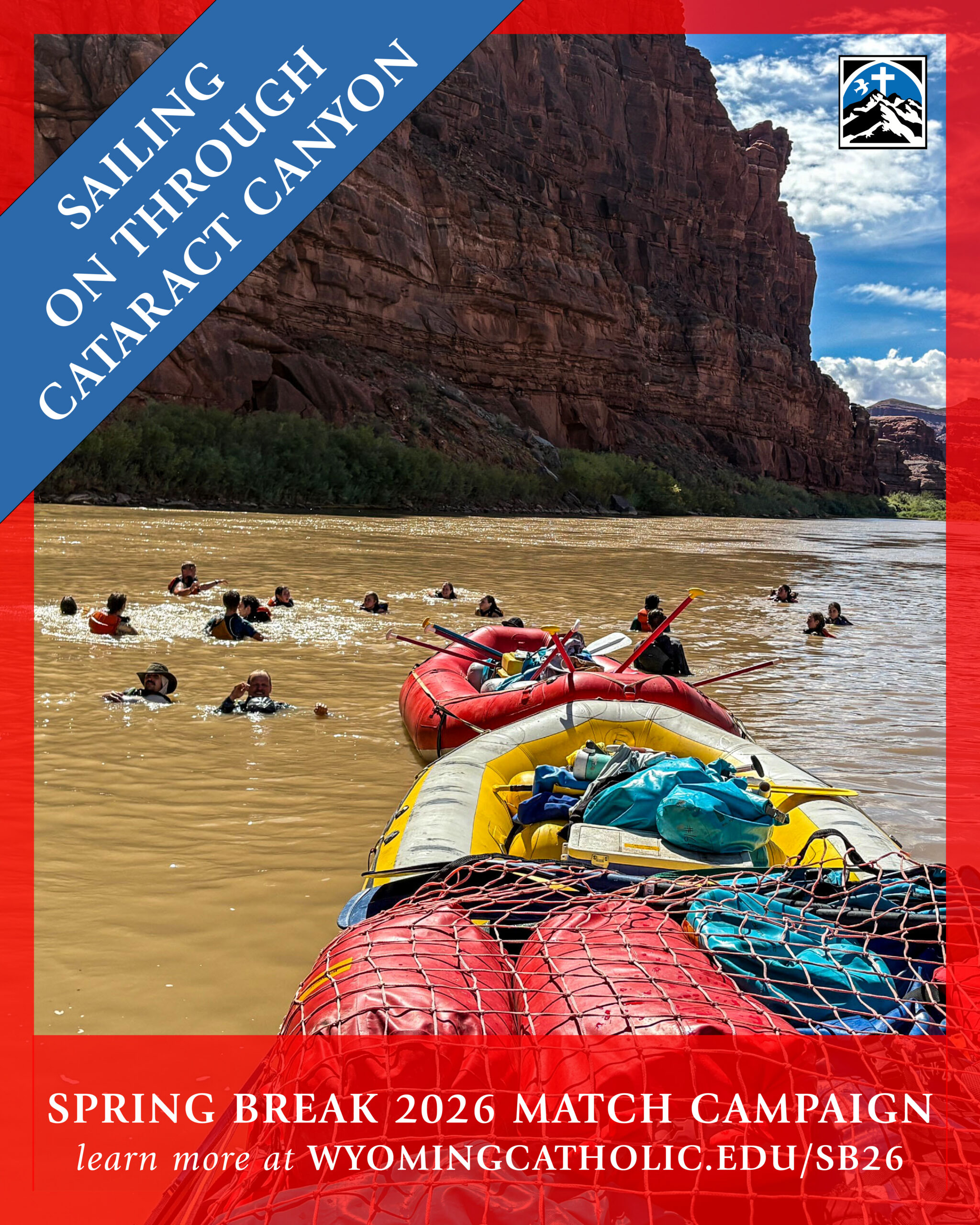
The white-water journey through Utah’s Cataract Canyon has long been a favorite spring-time adventure for Wyoming Catholic College students. A 46-mile-long stretch of the Colorado River located in southern Utah, it features fourteen miles of rapids, including several Class III and Class IV rapids and even a class V section. Depending on water levels, our students either paddle in a one-person pack raft, a two-person paddle cat (culebra) without a guide, or, if the water is high enough, large paddle rafts where one guide navigates the boat. (Depending on water levels and students’ ability, it is sometimes necessary to walk around a few of the more challenging rapids—a practice referred to as “portaging.”)
“I believe that the sound and sight of water is sacramental, reminding us of Baptism and of our thirst for Christ,” said one past participant, reflecting on why this particular week had been such a memorable experience. “So I always find peace and joy near the water, whether I am sitting at a mountain lake or canoeing on a river or rushing down series of canyon rapids.”
 The first organized exploration to travel the entire length of Cataract Canyon was the Powell Expedition, led by John Wesley Powell, a Civil War veteran who began his journey at Green River, Wyoming in 1869 and traveled in wooden boats down the tumultuous river to its confluence with the Colorado River. Apparently, the rapids terrified Powell and his men so thoroughly that they portaged their boats around every rapid they encountered, a time-consuming and arduous task. (It was the difficulty of the rapids that inspired Powell to name the location “Cataract Canyon.”)
Now, we’re not saying the fifteen students (and four support staff) on this trip are more adventurous and confident than Powell’s crew…Well, we’re not exactly saying that. But the time they’ve spent prepping for their “Cataract Cruise” in the weeks leading up to this particular Spring Break trip is carefully designed and calibrated to prepare them for the challenges that lie ahead. From hours at Lander’s Bruce Gresly Aquatic Center familiarizing themselves with the equipment they’ll be using on the river to the creation of a comprehensive, written assessment of the risks involved on each specific day and location that makes up the trip to the careful, thoughtful development of the expedition and interpersonal skills required for each of the students to work together as part of a coherent and effective team—all designed to make their trip down the roiling white waters of the Colorado a safe and fruitful one.
 The difficulty of this trip is not something to be dismissed quickly or lightly. But it’s also a key factor in why the Cataract Canyon adventure always exerts such a strong draw on our students. The turbulent waterway is sometimes described as “The Colorado River’s Last Wild Rapids,” and that wildness offers these adventurous young men and women the perfect opportunity to challenge themselves and to put the skills they’ve learned to the test. But it’s also easy to see why this particular group is nearly always accompanied by Dr. Tom Zimmer, the College’s Vice President for Outdoor Formation and Executive Director of COR Expeditions. (Managing risk properly is a huge part of what our Outdoor Leadership Program does best, and making sure you’ve got “the right people in the boat” is Lesson #1!)

The journey through The Cataract is a challenging one, and the upcoming days on the river will surely push our students to their limits. But the time they spend together this week is about much more than mere physical exertion. Each day’s “Integration Nugget” is designed to “integrate” their day on the river back into their academic life in Lander—reading and discussing Billy Budd will be a key part of this week’s adventure, as will story of Genesis and what that story tells us about Man’s relationship to Nature.
 There are numerous opportunities for relaxation, as well, whether it be “an incredible hike from the bottom of the canyon up to the rim called the ‘The Doll House,’ which leads you to beautiful red rock formations set against a glorious mountain backdrop,” a quick hike “to a gorgeous oasis in a small canyon with a little waterfall and a pool of cool water with moss growing on the bottom,” the rich (and humorous) conversations that spring up around the legendary Whisperlite cook stoves each evening, or the volleyball games that inevitably break out when the group arrives at their campsite after a long and challenging day on the river.
All in all, the Cataract Canyon trip is a perfect way to start off our week-long Spring Break Journey, highlighting the unique, incarnational education we offer our young people. This extraordinary blend of Mind, Body, and Spirit provides a formation found only at Wyoming Catholic College—a formation that produces joyful, energetic young men and women, filled with “grit and grace” and eager to tackle the challenges that lie ahead of them when they graduate, just like they’ve tackled and overcome the challenges of Cataract Canyon.
Please consider supporting these wonderful young people through this year’s Spring Break Match Campaign, and remember, everything we receive this week will be MATCHED by generous members of our Board of Directors, doubling the impact of your gift up to $50,000!
Gifts made through the form HERE will automatically be assigned to the Flash Campaign, and will appear in the Goal Meter at the top of the Campaign page as it is updated each day. If you would prefer to make a gift over the phone, via check, or through another philanthropic vehicle (such as a gift of stock or a mutual fund transfer), please contact the Office of Institutional Advancement at oia@wyomingcatholic.edu or by phone at (877) 332-2930, and the Advancement team will ensure your gift is assigned to the Spring Break campaign.