|
Wisdom Over Knowledge: Wyoming Catholic College’s Education for the Whole Person
|
|
|
|
In This Issue:
– Monthly Essay
–Announcements
– Campus Spotlight
– Featured Video
|
|
|
|
|
|
The answer to these questions is both subtle and fundamental. A graduate of Wyoming Catholic College recently reported the following story: In his graduate studies at a more mainstream Catholic university, he enrolled in a seminar course on the works of St. Thomas More, which was also open to undergraduates. At one point during the semester, the class was puzzling over More’s Epigrams, a series of cryptic, yet insightful sayings that reveal the Patron Saint of Statesmen’s views on a range of important subjects. Among the most confusing of the Epigrams are a series of seven variants of the same basic fable: that of a blind beggar striking a partnership with a lame beggar. Over the course of these seven distinct constructions of the same idea, More reveals much about the basis of political society. One of the undergraduates in the seminar was asked to give her interpretation of More’s underlying meaning in these epigrams. The question required her to apply skills of literary analysis to determine More’s authorial intent. After only a second’s pause, she replied with the simple statement, “Oh, I’m not an English major so….” The WCC graduate physically shuddered. How was it possible that an inquiry into the basic political thought of the Catholic Church’s epitome of statesmanship could be abruptly cut short by a doubt of disciplinary jurisdiction? How could this student cordon off entire spheres of inquiry merely because they transgressed an arbitrary line between academic fields?
This story, and many like it, illustrate the tragic consequences of academia’s drastic collapse into hyper-specialization. Half-hearted attempts at “core coursework” and interdisciplinary studies pale in comparison to the massive energy, resources, and cultural messaging invested in specialized programs of study. College students are told that, if they want to be successful after graduation, they need to become an expert in one particular “major,” and often in just one particular skill within that major. This university system is the intellectual equivalent of Henry Ford’s assembly line. College students occupy their tiny location in the college “thought factory” and plug away at the limited questions of their particular field. Few care at all, or even perceive, the intellectual “whole”–the big picture of what their education should mean. Intentionally forming a cohesive, balanced, well-grounded worldview is simply inefficient. Better by far to become specialized experts who are promised high-paying jobs! If we have to sacrifice purpose in life, moral character, and our spiritual well-being…so be it.
The destructiveness of this regimen can be seen in every field of intellectual inquiry. Contrary to popular belief, reality does not neatly segregate itself according to the different disciplines of the university system. Quite to the contrary, human experience is always a messy intermingling of various fields and sciences. As an example, consider the question, “What is the best political regime?” Despite many attempts by modern academics, this is a question that is clearly unanswerable by a single field. Perhaps the economics major would have many good things to say, but woe to us when political life becomes merely a story of dollar signs! Perhaps the lawyer will chime in with some orderly statements, but can his legalism truly capture the primordial bonds that bring human beings together in community? The so-called “political scientist” might claim authority, but what will he do when he learns that every human being is not just a “political animal” but also an image of God? The question, like all deep, meaningful, life-defining questions, is messy, tangled, and complex. What are we to do? Well, we must follow the example of men like St. Thomas More, who lived a brilliant political career only after pursuing an excellent education in every aspect of the liberal arts. Thomas More was a lawyer, a scholar of Greek, an arch-enemy of heretics, an enthusiastic student of literature, an orator, a philosopher, and most importantly, a devout servant of God. He wasn’t someone with a specialized “political science” major. This broad formation and grounding in truth allowed Thomas More to rise to the heights of England’s political order and, at the end of his career, to recognize the collapse of that order into tyranny and give himself to his Creator in martyrdom.
Students at Wyoming Catholic College face the question of the polis in Junior Year with PHL 302. However, they face the question only after spending five prior semesters studying natural philosophy, the philosophy of man, ethics, rhetoric, and the history and literature of our forefathers in Ancient Greece, Ancient Rome, and Medieval Christendom. After their philosophical study of political regimes in Junior Year, they will continue in Senior Year to study the instantiation of those ideas in American history and literature, and finally the culmination of Western political theory in the great works of Catholic Social Teaching during the 19th and 20th centuries. The fields of Philosophy, Rhetoric, Literature, History, and Theology are all applied to the all-important questions of how we should live as Catholics in our political communities. This kind of education is not the training of an intellectual assemblyman. This is the education of a human being, who is charged to explore and understand reality as it is, and not as it is made to fit neatly within the divisions of an academic catalog.
|
|
|
|
|
|
Campus Spotlight! – Mock Interviews
|
|
|
|
|
|
A hidden gem in Wyoming Catholic College’s curriculum is the four year Experiential Leadership Program (ELP). The outdoor component of this class is emphasized because of its uniqueness, but WCC’s leadership formation transcends the wilderness experiences. From the very beginning, WCC students are formed as leaders. They hone and practice their leadership skills in the ideal learning environment of the backcountry, where personal responsibility and discipline becomes paramount. However, they also study leadership strategies and keys to success in the public sphere in the classroom. Starting Sophomore Year, WCC students go on retreat every semester for an intensive course in career leadership, learning tools and tricks of the trade to stand out in the job market and thrive in the workforce. Students craft resumes, cover letters, hear from local business leaders about keys to success, and all the while reflect on what it means to be a prosperous Catholic. This component of the ELP program beautifully complements the Liberal Arts formation of our students, ensuring that they can take their excellent education and give it full fruition in the wider world.
|
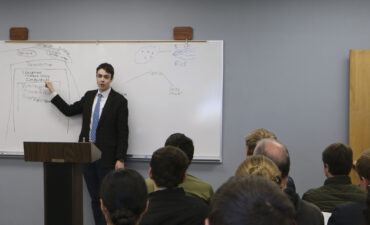
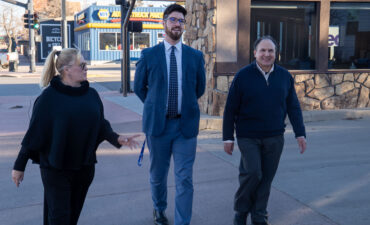
As a culmination of this curricular track, all WCC seniors experience a mock interview. Working with an advisor, they craft resumes and cover letters specifically tailored to a job they seek to secure after graduation. Then, they are matched with a volunteering business leader in that field who simulates a real interview experience–following up the assessment with critical feedback. Mock interview night is always an exciting time on campus. Seniors truly begin to prepare for life after graduation, and this shift is always accented by a combination of nostalgia and excitement. Mock interview night prepares our students to carry forward the goods they have fallen in love with at WCC–and thus to convert the world from within.
|
|
|
|
|
|
|
Join Us in Pursuing Wisdom in God’s Country!
|
|
|
|
|
|


 One of the most countercultural aspects of Wyoming Catholic College is the generalized character of our curriculum. As one of the few true liberal arts colleges, WCC offers a unified curriculum in the timeless disciplines of liberal education. WCC students do not pick one major out of hundreds or even one department out of several. All WCC students take the same classes in the same order and graduate with the same degree: a B.A. in Liberal Arts. At first, many prospective students are skeptical of this approach. “What can I
 Early Application Scholarship!
 Open House Program!
 PEAK 2026 Is Open!
 WCC Webinar!
 WCC on the Road!