“Enchant every word with truth:” Nyra Ortiz (‘25) on the Writing Lab at WCC
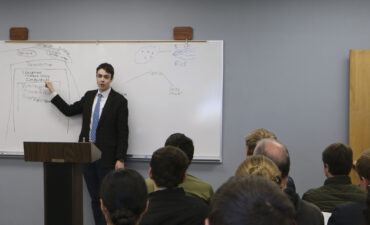
Since its founding, Wyoming Catholic College has instructed students in the rhetorical art of writing. Fundamental skills of expression are taught through the Trivium track and practiced in assignments distributed across every department over the course of four years, culminating in the senior thesis and oration. Many students, however, have needed more intensive assistance with writing assignments. To fill this need, Nyra Ortiz (‘25) “accidentally invented” the Writing Lab as a student and now serves as the Writing Lab Coordinator for her alma mater. In the following essay, she expresses some of her thoughts on the writing process and the enduring importance of writing.
 Words are cheap in a world awash with them. We are bombarded with thousands of words—reflective, blinking-neon, graffitied, screamed, obscene, blabbed, rapped, or crooned through the radio—on our daily commute. Children learn to swipe-text ninety words a minute, auto-filling figures of speech and emoji in arbitrary alteration, before they begin to laboriously scrawl their names in shaky green crayon. Students hasten their typing rather than refine their handwriting, while professionals command AI rather than communicate with coworkers and clients. Billboards, blogs, vlogs, live chats, and comment sections give everyone a voice: the more you pay, the louder and further your word is broadcast. LLMs chatter like reanimated skeletons and hallucinate like feverish poets—that is, when they’re not “helping” professors read papers which their simulated brethren “helped” students write.
Why should anyone learn to write when we stand on the precipice of an age of command? If words have been so devalued, why contribute to the inflation?
 Because “one word of truth shall outweigh the whole world.” This Russian proverb, which Aleksandr Solzhenitsyn famously bestowed upon the world in his 1972 Nobel Lecture, reflects an age in which words were weighty, worthwhile, carefully wrought, and dearly bought. Now, however, words are ubiquitous. We navigate the world by them, code, calculate, conduct business, woo and wed, enrage and allay; we have made words tools rather than vessels of truth. In the process, we have banished that age in which the worth of words was recognized, watering down words by sheer quantity until they are rendered practically meaningless, placing our trust in armless programs which grow like kudzu. Writing has become little more than connecting words. And everyone and his AI girlfriend can do that.
Writing was once understood as rhetorical, rhetoric as “the art of soul-leading by means of words.” In our day, technology has enabled the unthinkable, allowing us to sever words from souls, speech from tongues, writing from thought. Truth, however, it has left untouched, as even an indiscriminately ravenous coyote refuses to clamp his maw down on a blazing fire. Truth, like fire, is among the human arts; it is our pride and our defense. Truth, if present at all in the products of AI, is merely an accident of the process; stringing words together according to statistical likelihood is not a very efficient way to philosophize. Nevertheless, truth remains attainable without extending our reach and our being through technology; we must write with truth as the essence, the substance, of our work, recognizing that we ourselves have the capacity to revalue words and revive that age in which words had worth.
 Words are valuable when painstakingly mined out of a dense and layered text; delicately cut to reflect and communicate light through every fascet; and deftly set in a gilded bezel with a master jeweler’s refined touch. The product might be resplendent, fit to adorn a queen or transform the beloved into a fiancee, or else it might be ruined by an unskilled touch, a single cut awry, a pressure fracture unlocked by the unbearable heat of the process, shattering the precious whole into mere fragments of unrealized potential. Just as the rare, brilliant lustre or dull, glassy surface of a gemstone is developed gradually, so the value of words is compounded or detracted by every part of the writing process.
The failure to produce a masterpiece is a disaster, though rarely known to anyone beside the lapidist; when a jewel shatters in the workshop, the world is robbed before it realizes its wealth, the earth plundered for naught, a hundred thousand years of pressure, heat, and repose irretrievably wasted. Why do we not consider the failure to produce a dazzling piece of writing a “disaster”? Because it is rarely known to anyone besides the writer? No—because we have devalued the product, buying cheap fakes while ignoring the expertly cut and artfully framed masterpieces of the craft.
 At Wyoming Catholic College, we reject cheap fakes along with deep fakes and teach students how to think and how to write. In fact, we require thinking and writing in every department of our curriculum. Beyond this once-standard expectation of academia, we direct students toward a lofty goal: enchant every word with truth.
Is it ambitious to expect undergrads to discover, refine, and expertly set literary jewels? Yes. Wholeheartedly I admit it. But is such an expectation entirely unfounded when the students in question first proved their gumption by spending three weeks in the wilderness, racking up eighty to a hundred miles by foot, warding off wildlife and weathering the fury of the elements, soaking in the splendor of a bejeweled night sky? It was arduous; it was awful, in the precise sense—it was full of awe. The grueling days heightened their imaginations as much as the raw, unfiltered, unInstagrammed heights and sights around them. Through the wonders and the trials, they discovered a deep capacity for blazing beauty and developed a spirited endurance in pursuit of noble goals.
This shared experience is the basis of my audacious trust in their ability. Tolerance for adversity transfers from the peaks of the Rockies to the expanses of the Great Books, from the backcountry to the intellectual life. At Wyoming Catholic College, the writing process is challenging, not primarily because of the length required nor because of numerous overlapping assignments, but because of the depth expected. Whether essaying forth in Humanities, Philosophy, or even Mathematics, every completed work of writing is the product of a tripartite process of discovery, refining, and setting: we call these three phases invention, organization, and style.
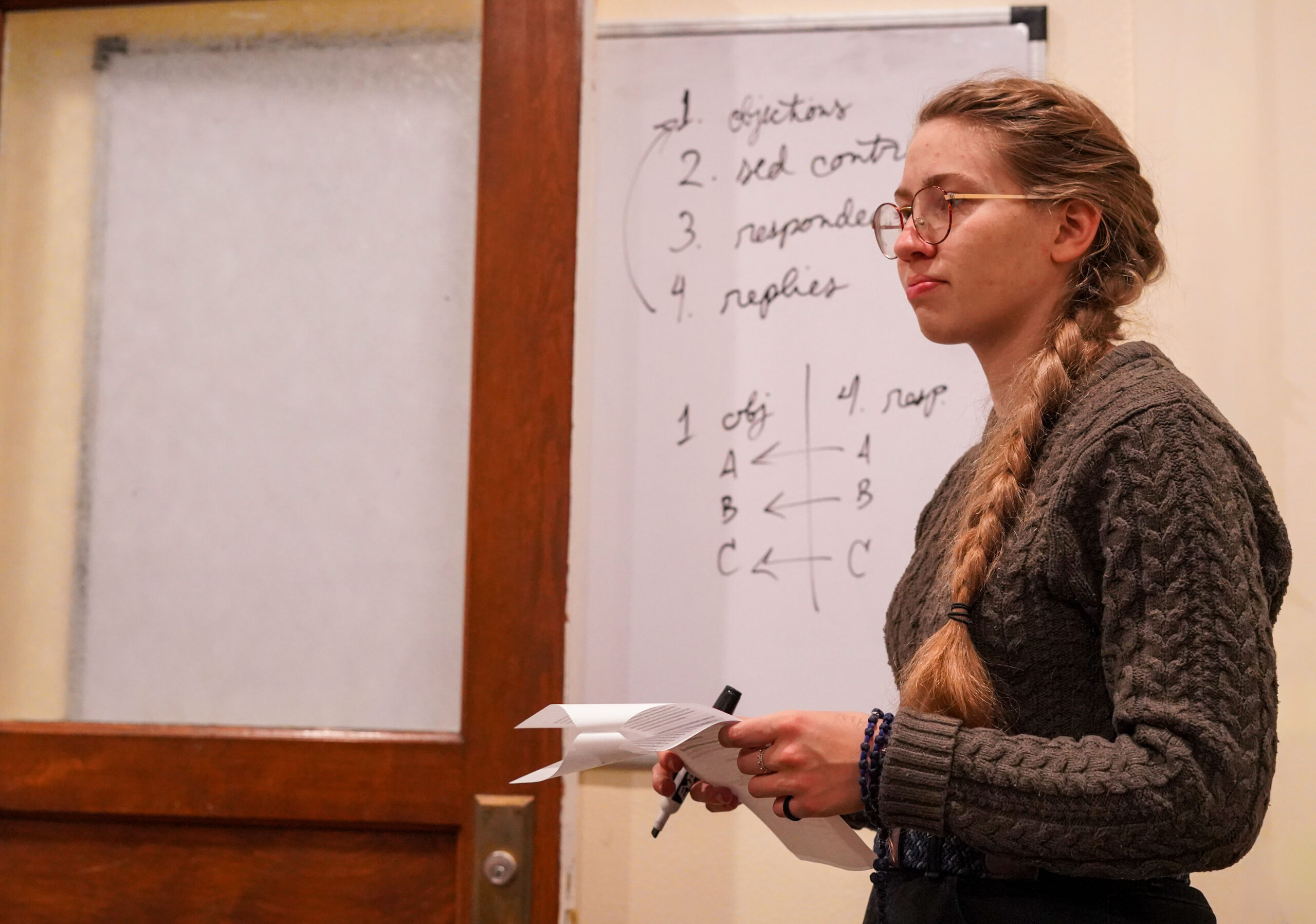
 Freshmen learn and explore each of these “discrete but related elements of the art of composition,” drawn from the classical tradition of rhetoric, in the Trivium 101 course. However, just as it may not be immediately clear how spending forty minutes trying to stake down a tent in a wind tunnel might make one a better student, so it can be difficult to effectively apply the principles demonstrated in class to self-directed assignments. Accordingly, the Writing Lab was established last year to assist with transference and to supplement the foundational training in writing as a rhetorical art. Practically, this means tutoring according to the principles of the Socratic method: asking questions to lead to understanding rather than mere red-pen proofreading, which teaches students to avoid what is wrong rather than to strive for what is magnificent, noble, beautiful. Both the Trivium track and the new tutoring program emphasize writing as a logically-ordered process, without excluding the wondrous spontaneity of the Muse. In The Office of Assertion, a constant companion of WCC freshmen, Scott F. Crider concisely explains, “invention is what you argue; organization, in what order you argue; style, how you argue.” Though he captures the essence, I’ve begun to elaborate each aspect as follows.
Invention is the process of discovering ideas. While it is analogous to the concept of “brainstorming”, the Latin root in-venire suggests an orderly, thorough, directed search by which we come into ideas, not a tempestuous scattering of mental energy, throwing text and thought into disarray until the two coalesce into something workable. I like to think of invention as dialing the Muse’s phone number rather than waiting for her to give you call. The misconception that you “can’t write” until this airy, nebulous, elusive thing called “inspiration” strikes is a pervasive and abominable lie which swindles students out of their best work and into creative arrest while they wait for the goddess to breath that grade-saving breath into their system. And what if she should never arrive at the scene? Why wait until CPR—that is, Critical Paper Revival, of course—becomes necessary, when you can learn techniques to get a goddess at your beck and call?
 These techniques include asking specific questions which can by applied to any topic or text to spark deeper analysis; identifying overarching themes and important connections between texts; developing threads from classroom or lunch table discussions; and progressing possible arguments with precise syllogistic logic. The role of the tutor in invention-based sessions is to ask piercing questions, draw out fruitful connections, and indicate overlooked aspects of the text. Group invention sessions not only allow students to hear ideas beyond their own, but they demonstrate that writing is a conversation with peers as well as predecessors rather than an isolated pursuit. Through these methods, we guide students as they develop their initial thoughts and drive toward arguable theses. With an hour or two of dedicated invention, students bereft of ideas can produce such a surplus that they could not possibly include them all in one essay.
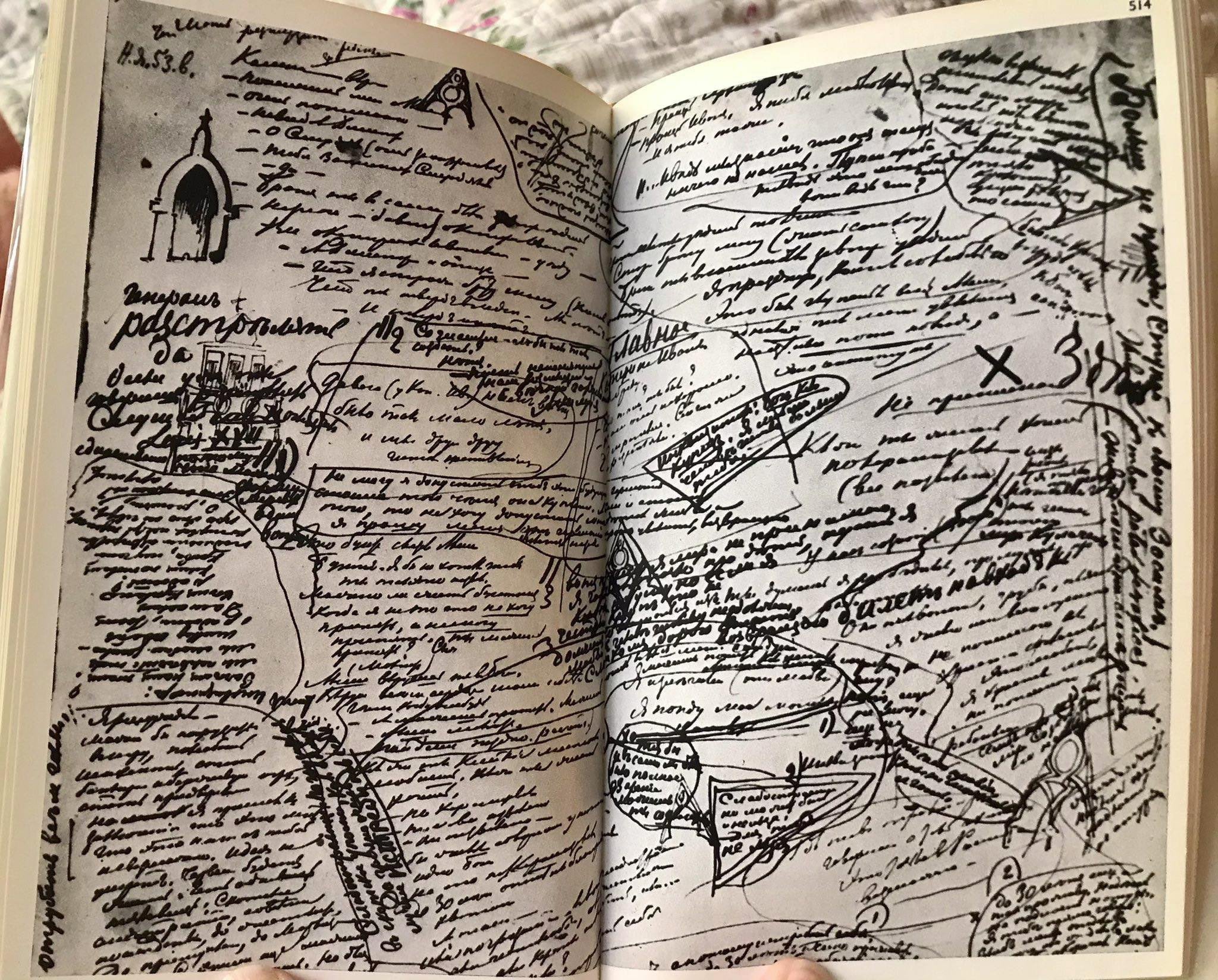
Organization is the process of structuring these newly-gathered ideas. It requires students to consider what might be the best way to present their arguments, then to rationally order their thoughts in the most convincing and engaging form. The classic outline remains the perfect tool for the job; I encourage students to produce at least two outlines before beginning to write in earnest, because I think of an outline like a “writer’s sketch.” Knowing how expensive oil paints are, for example, only a prodigious or a prodigal painter would slather them over his canvas without making several sketches first. Ink, perhaps, is cheap these days, but time is valuable—particularly for students writing on a deadline. Half an hour of outlining can save hours of reorganizing work later in the process.
 There is another reason, however, why an extended organizational phase is never a waste of time: in the process of ordering thoughts, students practice ordering souls. Admittedly, the audience for an undergrad essay is very limited, frequently consisting of no one besides the professor and the writer himself. Whether or not he entertains serious hope of convincing his professor, the student writer still should strive to move him; more importantly, he must convince himself. He will not be able to lead the souls of others unless he can first lead his own. Professors do not want to read essays written simply for the assignment any more than students want to write them—both know that there is no heart in it. An argument with no heart is sycophantic drivel, academic propaganda, intellectual busy-work; give me rather a fiery, impertinent, completely misguided attempt to advance some absurd claim any day. If nothing else, convince me that you believe in what you are saying, and believe that it is worth saying—that your soul will not be still until you have said it. Boiling indignation is workable, it simply needs to be expressed appropriately, but tepidity is irredeemable, no matter how tastefully dressed it may be.
Style is the process of composition itself. Once you have gathered and ordered your ideas, you must decide how to express them. Just as an experienced tradesman knows precisely when and how to use every tool in his toolbox, so an excellent writer thoughtfully and appropriately applies every tool at his disposal. And what populates a writer’s toolbox? Vocabulary, clauses, phrases, punctuation marks, tropes, figures of speech. Proper use, however, consists of not simply “dressing up” an overdone topic or underdeveloped thought, but constructing a meaningful, functional, and beautiful argument that demands an intellectual response from the reader, invites his admiration, and moves his soul.
 To strengthen the foundation of style, the Writing Lab offers weekly grammar workshops to review the basics of syntax and punctuation. The baseline for style is clarity: mangled sentences, misplaced dots and lines, and commas spliced with impunity are quick and easy ways to strangle your ethos; whatever you are trying to say—no matter how revelatory it might be—it won’t be heard unless the airway is clear. The goal, however, is elegance and grace, flowing from the freedom of mastery. Accordingly, we emphasize that the conventions of grammar are not arbitrary, but essential to soul-leading style. Helping individual students sharpen their style entails working through their writing, line by line, word by word, applying a few overarching principles to the nitty-gritty particulars: avoid trite figures of speech, eliminate clunky phrasing, “omit needless words,” make sure that you really believe everything you wrote and expressed everything you believe. Because “what is above all needed is to let the meaning choose the word, and not the other way about.” It is easy to drift away on a barge of pretty, pleasant, or pretentious words that mean nothing, but we must resist and remember that the goal is to lead by our words, not to be lead away by them.
The purpose of the Writing Lab is to assist students in the life-long process of learning to lead their own souls; until capable of this, no writer may hope to beget words that will outweigh the world. Training in rhetorical writing is needed now more than ever, not simply because of the nascent siege of academia conducted by unprecedented forms of AI, but because writing remains a critical part of education understood as formation. Writing requires virtue: prudence to balance economy and imagery; restraint from disruptions, distractions, and the new temptation of the unthinking route; courage to contradict; endurance to complete; respect for the reader; and, above all, love—or rather, two tangled loves, one for the subject at hand, another for the craft itself, which, for a true artist, can hardly be distinguished. Only once the roots of these intertwined loves thread through the coronary arteries and the branches wind through the gyri and sulci of the cerebral cortex and the canopy purifies the immaterial air of the soul can a writer be worthy of the words he writes.