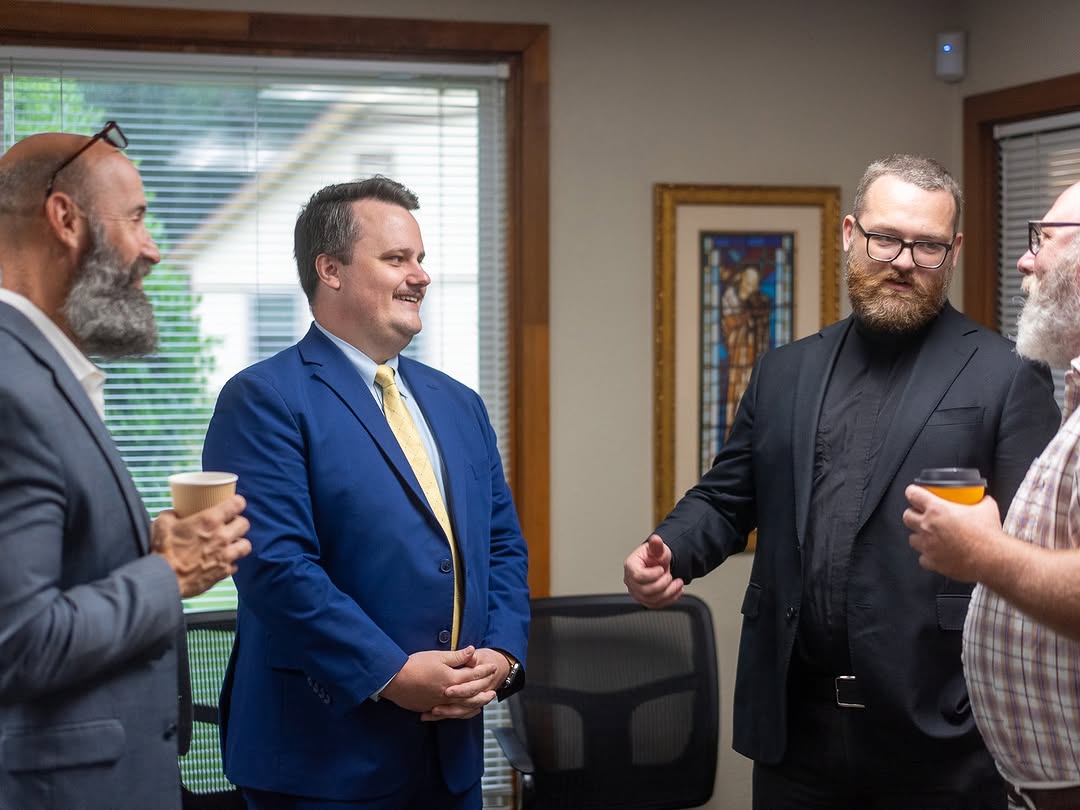
Isaac Owen
Development Director, Diocese of Tulsa and Eastern Oklahoma
After graduating from Wyoming Catholic College, I worked for a variety of nonprofit organizations in think tanks and politics before putting my talents to work on behalf of the Catholic Church, first in Michigan and now in my native Oklahoma. I currently serve as Director of Development for the Diocese of Tulsa and Eastern Oklahoma. Since graduating, I have helped raise and steward over $25 million for various organizations and causes.
But the real key to whatever success I have had did not begin in an office or a fundraising seminar. It started at Wyoming Catholic College. Education at WCC seeks to teach students to see with eyes open to the world. WCC taught me to look at the world and at people with wonder. I learned to encounter each person as someone made in the image and likeness of God, and that vision has shaped how I listen, connect, and invite others into the mission of the Church. When you have learned to see reality, you learn to see people in the same way. They become gifts rather than instruments, and mysteries to be encountered rather than tasks to be managed. That shift, more than any technical skill, has made me a better fundraiser and a better servant of the Church.
At WCC, both the classroom and the wilderness teach you to see the world as enchanted. This is not a superstitious enchantment but an openness to truth, beauty, and goodness that reveals God’s presence in all things. Whether it is reading Dante under the stars, celebrating Mass on a remote mountain peak, or sharing a late-night conversation with a friend who will someday be the godfather of your child, WCC forms you to experience the world as it was truly meant to be.
This vision carries into every aspect of my life now. It allows me to approach each person I meet with genuine curiosity and deep respect. It allows me to speak about the Church’s mission not as an abstract cause but as a living reality that has shaped me. It allows me to invite others to join that mission, not through pressure but through shared purpose and shared hope.
The magic of WCC is not an escape from the real world. It is preparation to engage the real world with clarity, love, and a sacramental imagination. And that continues to guide my work every single day.